
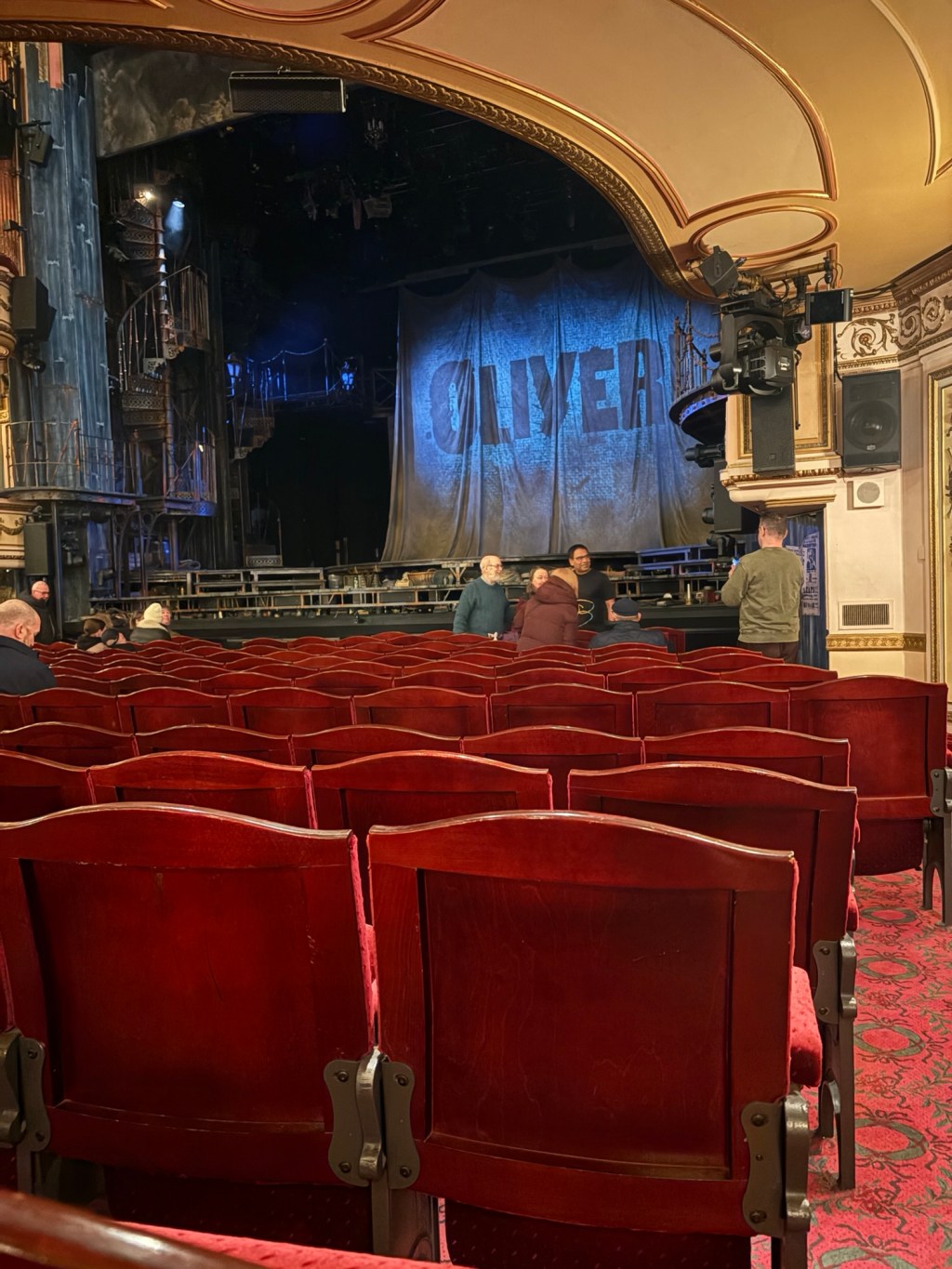
I must be honest. When I arrived at the Gielgud Theatre and saw my seat, my expectations for the evening immediately dipped. There was no warning whatsoever that one of the most important entrances in the entire show would be out of view. Granted, it did not affect most of the performance, and once the lights fade you barely notice the circle above. But this is not an unobstructed view. When so many London theatres warn audiences about even the smallest possibility of a blocked sightline, the evening began with a slightly sour taste in the mouth.
It is funny, isn’t it. Most of us buy tickets for the Oom Pah Pah and the Consider Yourself of it all, myself included. Yet I had never quite realised how bleak and twisted the story behind those cheerful tunes really is. In this production it is almost impossible not to notice. At several points I found myself quite literally reviewing the situation.
This revival is brooding, moody and relentlessly unforgiving. Every morsel of Dickens seems to have been lifted from the novel and exhaled onto the stage. Visually, it is striking. Dramatically, it occasionally exposes how much Lionel Bart’s book lingers on its darker impulses.
Simon Lipkin’s Fagin feels fully realised. Lipkin grounds the troublesome figure with a performance that acknowledges the character’s difficult history while still leaning into his comic instincts. Unfortunately, there is often one joke too many. A genuine laugh can easily turn into a groan when the next gag arrives just as the scene should be shifting toward something darker or more unsettling.
Ava Brennan’s Nancy, however, is the revelation of the evening. Nancy can often drift toward caricature before pivoting into tragedy, but Brennan gives her a fully embodied inner life. This is a woman who knows her worth, understands the brutal system around her and recognises that, given a fair chance, she could have escaped it long ago.
The issue is not Brennan’s performance but the pace of the production around her. Nancy is rarely allowed to linger in a moment. As Long As He Needs Me is delivered with emotional precision and the audience almost reaches the point of genuine devastation, only for the surrounding momentum of the staging to rush onward before that emotion has time to settle.
The wider cast perform with enormous energy, particularly in the ensemble sequences. Yet many of the supporting roles are written as broad Dickensian sketches, which naturally leaves Fagin and Nancy as the only characters afforded real psychological depth.
Aaron Sidwell’s Bill Sikes lurks in the shadows with chilling precision, landing just on the right side of pantomime villainy without ever tipping fully into it. It is perhaps because of that effectiveness that sections of the audience booed Sidwell’s bow on the night I attended, something I have always disliked in musical theatre. It is the actors taking their bows, not the characters.
The show itself looks sensational. Matthew Bourne’s choreography frequently carries the evening, particularly in the sequences involving Fagin and the boys. These moments provide some of the production’s most exhilarating images. All of this unfolds against Lez Brotherston’s grey industrial set which would not look entirely out of place down the road at Les Misérables. At one point I found myself joking that perhaps Cameron Mackintosh had reclaimed the revolve and instruments from that production simply to power this one.
There is rarely a static moment on stage. The production captures the grime and claustrophobia of Dickensian London so effectively that you almost feel as though you are walking through its fog filled streets yourself. Yet when the machinery of the staging accelerates toward the finale, the momentum becomes so relentless that the ending risks feeling strangely rushed.
The cast are sensational. The young performers work tirelessly and the joy of performing this material is written all over their faces. Ryo Appadu carries the title role with a sincerity that avoids the cloying sweetness Oliver can sometimes fall into, while Aaron MacGregor’s Artful Dodger brings a welcome spark of swagger and mischief whenever he bounds onto the stage. When the inevitable standing ovation arrived, it was one of the few I have witnessed recently that felt entirely earned.
The production certainly looks like a million pounds. Whether anything on that stage truly justifies ticket prices reaching £225 is another matter entirely.
Still, Oliver! remains one of the rare classic musicals that largely earns the hype surrounding it. I just hope that, after its inevitable UK tour, we allow it to rest for a while. Some titles deserve the occasional triumphant revival. They do not all need to become permanent residents of the West End.
 Colin Cushion
Leave a comment