
Spoiler note:
This review reflects on specific moments and mechanisms within The Producers. I experienced the production with no prior knowledge of the show and believe that approach fundamentally shaped its impact. Readers planning to see the production and wishing to go in blind may prefer to return to this review afterwards.
Never, in all the years and all the shows I have seen, has a piece of theatre made me freeze. My face dropped. I understood exactly what the show was doing in that moment, fully aware of the irony of an audience being swept along by the comedy of it all. Since then, I have found myself returning to that reaction, wondering how many others felt the same, and how many simply moved on.
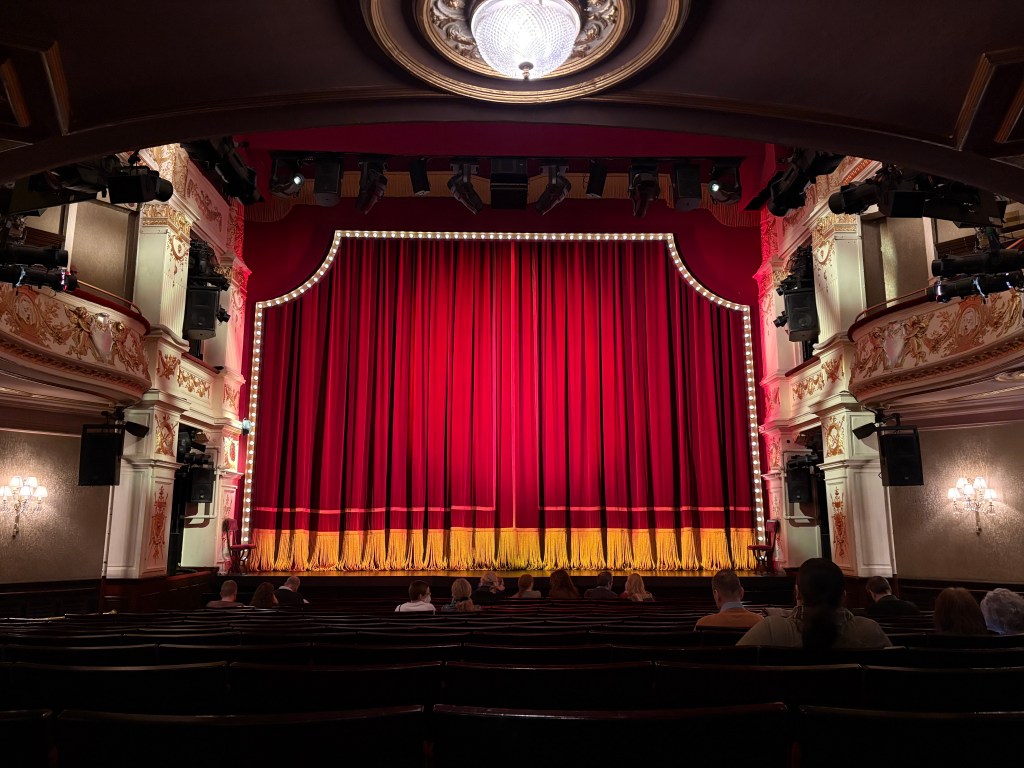
The Producers at the Garrick Theatre, transferred from the Menier Chocolate Factory and directed by Patrick Marber, is explosive. The production barely seems able to fit on the stage of this matchbox-sized theatre, yet that compression only heightens its effect. It is equal parts chintz, camp, and outrageously funny. This is frivolity for the sake of frivolity, and a direct middle finger to the audience and to the industry from which it comes. The show invites you to go along with an extortion plot, to become complicit in the production of a show so deliberately abhorrent that it is destined to succeed, stopping its creators dead in their tracks.
There is a danger in trying to make sense of The Producers too early. The show relies on momentum before meaning. If you apply the brakes while it is still accelerating, you risk losing both yourself and what the piece is about to do to you. It is theatre designed to act upon its audience before inviting reflection, not alongside it.
I had somehow heard endless praise for The Producers over the years without ever learning much about its plot, characters, or tone. In retrospect, this felt like the ideal way to encounter it. From the outset, you are in on the joke. The motives are laid bare, the mechanisms visible, and the fourth wall all but obliterated through knowing glances and moments of direct address. Nothing is hidden. The show does not trick its audience so much as dare them to keep up.
The set is fairly minimal but used to great effect, with Scott Pask’s design providing just enough structure for the chaos without cluttering an already busy stage. Lorin Latarro’s choreography dazzles, impossibly tight and precise in a space that could barely accommodate the swinging of a Zimmer frame, made all the more effective by Paul Farnsworth’s costumes, which fully embrace the show’s gleeful excess. Tim Lutkin’s lighting design is genuinely inspired, perfectly complementing the musical’s rhythm and tone, heightening the comedy while lending clarity and punch to moments that could easily descend into visual noise.
Initially, I found myself unsure whether Mel Brooks’ book and lyrics were utterly inspired or completely stupid. That uncertainty is part of the design. Once I stopped trying to impose meaning before it arrived, the answer became clearer. This is not Shakespeare, nor is it trying to be. The characters are built with deliberately shallow arcs, and you are not meant to like them. The show blinds you with comedy, allowing little time to question what is happening until it has already happened.
Refreshingly, each of the principal characters is given their moment to shine, making it impossible to single out a standout performance. That balance is intentional, and it is sustained by an ensemble that does much of the heavy lifting throughout. Each member moves seamlessly between roles, grounding the production and maintaining its relentless pace. Without that collective precision, the show would quickly unravel.
Act One barrels forward with remarkable speed. Act Two, by contrast, slows down. It serves the structural purpose of pulling together the few plot points that exist, bringing the audience firmly back to the ground while remaining consistently funny. That grounding is necessary, though it comes with a cost. I spent much of the second act questioning my own reaction to what had come before, and as a result felt momentarily removed from parts of the show. Cleverly, The Producers anticipates this and gradually wins people like me back, restoring its rhythm and confidence.
It is impossible to discuss this production without addressing the Springtime for Hitler sequence. In that moment, I felt genuine whiplash. Not offence, not shock, but a sudden awareness of how easily spectacle works. Throw enough comedy at something awful, add a sprinkle of glitter, and suddenly anything can become fair game. The laughter is enormous, sustained, and deliberately encouraged. That reaction is not incidental; it is the point.
In the current global political climate, that mechanism lands with particular force. Where productions like Cabaret confront their audience with anger and urgency, The Producers disarms through laughter. It does not shout its warning. It makes you laugh first, and only afterwards leaves you to question what you were so ready to enjoy. The discomfort does not arrive in the theatre so much as follow you out of it.
Long after the curtain call, it is difficult not to keep thinking about this musical. The score itself is largely forgettable, and that too feels intentional. Even the orchestra initially feels absorbed into the machinery of the show, so seamlessly integrated that it briefly registers as recorded sound before being revealed, dream-like, as part of the spectacle, under the musical direction of Matthew Samer. There are few melodies designed to linger, with the most repeatable by far emerging from Springtime for Hitler itself. Memory, here, is tied not to pleasure but to disruption.
This revival of The Producers is technically accomplished, sharply staged, and unapologetically confident. More importantly, it is a piece that understands exactly how it functions on an audience. It invites complicity, delivers spectacle, and trusts laughter to do the work. Whether that laughter feels comfortable is left unresolved.
What remains is an unsettling clarity: comedy can make almost anything palatable, provided it moves fast enough. The Producers knows this, exploits it, and leaves its audience to decide what to do with that knowledge afterwards.
 Colin Cushion
Leave a comment