
George Naylor is magnetic in this play. His energy keeps the audience hanging on his every word, even when the exposition begins to spiral and the plot threads multiply.
I can’t spoil the plot, partly because I’m not entirely sure which threads ultimately mattered and which did not. There are too many ideas simmering in the potion. And yet, the result remains intoxicating, staging that is visually arresting and storytelling that becomes genuinely compelling in Naylor’s hands.
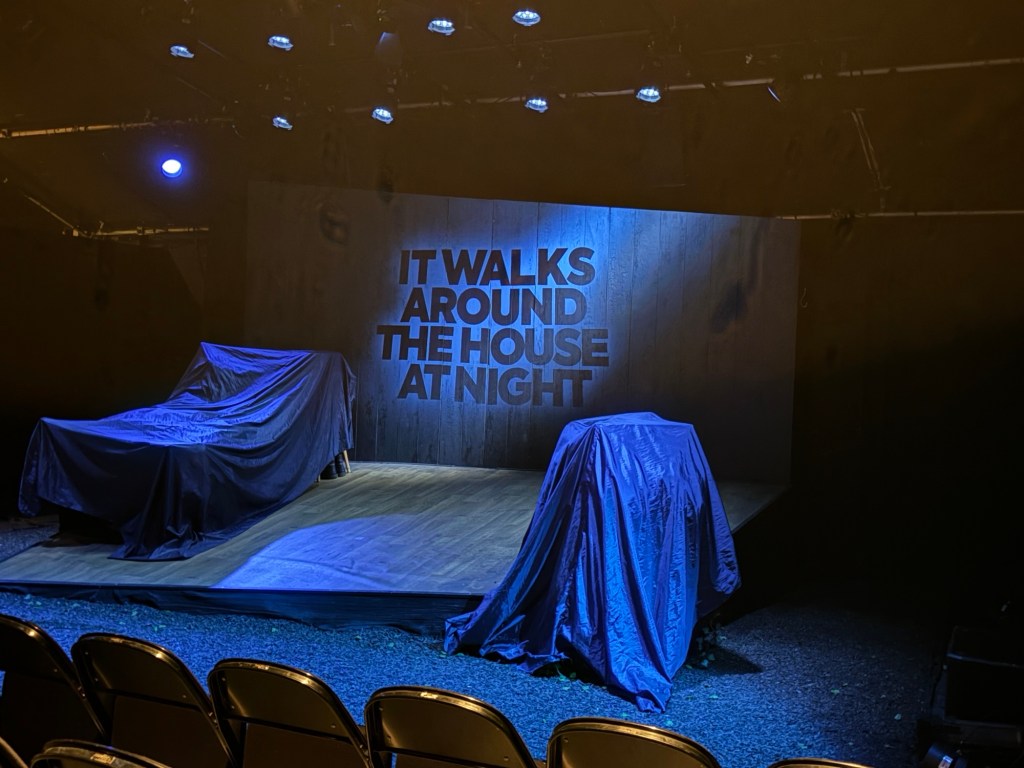
Almost all of the show’s foibles can be forgiven because this is a feast for the eyes. Neil Bettles and Tom Robbins’ set design, paired with Joshua Pharo’s lighting and video work, is pushed to its limits, and there are one or two jump scares that land near perfectly. It is one of the few productions where projections feel justified. Here, they enhance rather than distract.
The choreography is sensational. Projection, lighting and physical effects combine in ways that immerse the audience in what is otherwise a minimalist world. Pete Malkin’s sound design works beautifully alongside the visual elements to create moments that feel almost cinematic in scale. If anything, the soundscape could be pushed further, allowing the more unsettling moments to land with greater force.
Every time the show appears to have reached its peak in scale, something else looms larger or closer. One moment in particular, when the protagonist finds himself fleeing the shadows, is genuinely jaw dropping.
Audiences are more than willing to be scared if the play earns it, and yet so often stage thrillers hesitate at the crucial moment. That is where this play holds back. It sets up the potential, invites you to stare it directly in the eye, and then pulls you away from it.
I would also love to see more shadow play. During one moment involving nothing more than a phone torch, the production briefly taps into something far more unsettling, reminiscent of The Woman in Black. It works, but it feels like the beginning of something the show never fully commits to.
The final twist feels rushed. It carries significant build up, but when it arrives it passes quickly. The idea works, but the moment demands a larger theatrical payoff. For a production billed as a “theatrical horror experience”, this feels like the one moment that should overwhelm.
There are simply too many characters. Although each is performed with skill and commitment, several serve little narrative purpose and do not meaningfully contribute to the unhinged final moments.
Given that the piece is performed by only two actors, it might also benefit from more offstage voice work to clarify certain exchanges. During several phone call sequences it was not always clear who was speaking, or whether lines were being repeated or performed by another character.
That said, this remains an impressively executed production. Tim Foley’s script, under Neil Bettles’ direction, is clearly aiming for something ambitious, even if the storytelling occasionally tangles itself. At times the piece seems caught between being a stage thriller and a horror film translated into theatrical language.
If it leaned more firmly into theatricality, the story might benefit from more breathing space and fewer competing ideas. Alternatively, if it embraced the grammar of horror cinema more fully, some of the exposition might be introduced earlier and with greater ease.
There are excellent moments throughout, but the later scenes move at such speed that it becomes harder to stay emotionally invested. Quite why Joe ultimately requires rescuing, when he appears capable of extracting himself from his own situation, remains unclear.
I found myself thinking back to Ghost Stories, which builds tension effectively but, for me, never quite delivers visually. This production often achieves the opposite. It dazzles aesthetically, even if the storytelling occasionally struggles to keep pace.
One small staging choice stood out. At Southwark Playhouse Borough, the set sits noticeably off centre, leaving a pocket of darkness to the right of the stage. Sitting on that side, the empty space felt deliberate, as though something might emerge from it. Whether intentional or not, it added to the sense that the production was always building towards something just out of reach.
This recent resurgence in staged thrillers is exciting. The Woman in Black still reigns as the benchmark, but this production feels fresh enough to avoid imitation, in the same way Paranormal Activity finds its own language within the genre.
This play feels tantalisingly close to something extraordinary. With greater confidence in its scares, and a little more restraint in its storytelling, it could become something genuinely spectacular.
I would highly recommend catching this show while you can. It is selling out quickly at Southwark Playhouse Borough and runs until 28 March. This will not be the last we see of it.
 Colin Cushion
Leave a comment