
George Naylor is infectious in this play. His energy has the audience hanging on his every word, even when they find themselves momentarily lost in the seemingly endless exposition and winding plot points.
I can’t spoil the plot, partly because I’m not entirely sure which threads ultimately mattered and which did not. There are perhaps one too many ideas simmering in the potion, but the result is nevertheless intoxicating, staging that is visually arresting and storytelling that becomes utterly compelling in Naylor’s hands.
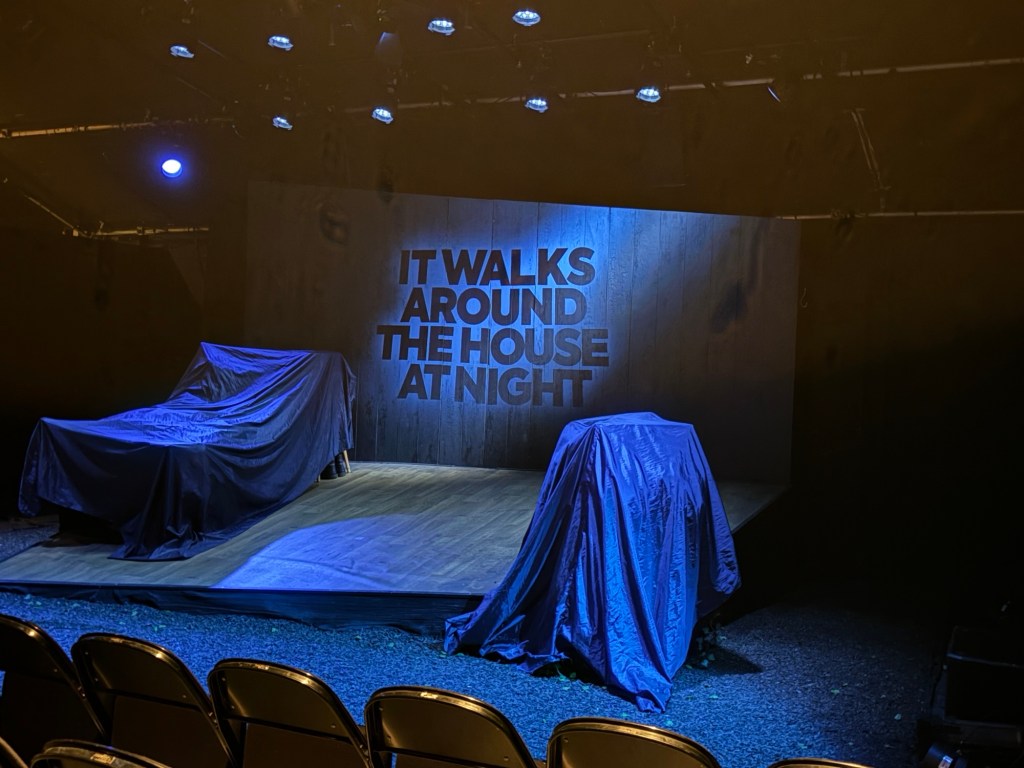
Almost all of the show’s foibles can be forgiven, because this is a feast for the eyes. Neil Bettles and Tom Robbins’ set design, paired with Joshua Pharo’s lighting and video design, is used to within an inch of its life, and there are one or two jump scares that land near perfectly. It is also one of the few circumstances in which I can forgive the use of projections. Here they genuinely enhance the aesthetic rather than distract from it.
The choreography of the production is sensational. Projection, lighting and physical effects combine in ways that genuinely immerse the audience in what is otherwise quite a minimalist world. Pete Malkin’s sound design works beautifully alongside Pharo’s lighting and video work to create moments that feel almost cinematic in scale. If anything, the soundscape could occasionally afford to be pushed a little louder, allowing some of the more unsettling moments to land with even greater force.
Every time the show appears to have reached its peak in scale, something else looms larger or closer. One moment in particular, when the protagonist finds himself fleeing the shadows, and I will avoid obvious spoilers here, is genuinely jaw dropping.
Audiences are very much up for being scared witless if the play earns it, and yet so often stage thrillers teeter on the edge of genuine terror only to shy away at the crucial moment. That is where this play occasionally holds back. It sets up the potential, invites you to stare it directly in the eye, and then brutally pulls you away from it.
I would also love to see a little more shadow play. During one moment involving nothing more than a phone torch, I found myself suddenly very excited. It felt very much in the tradition of The Woman in Black. “Here we go,” I thought, practically rubbing my hands together. The reveal did elicit a couple of genuine screams from the audience, though I could not help wishing the production might push even further in moments like these.
The final twist also feels slightly rushed. It carries enormous build up throughout the piece, yet when it arrives it passes quickly. The idea works, but the moment seems to invite a larger theatrical payoff. Given that the production describes itself as a “theatrical horror experience”, this feels like the one moment that could support something truly overwhelming. I appreciate the practical limitations of staging physical effects within the audience, but the anticipation here feels strong enough to justify something even bigger.
There are simply too many characters in the play. Although each is performed with real skill and commitment, several ultimately serve little narrative purpose, nor do they meaningfully contribute to the unhinged final moments.
Given that the piece is performed by only two actors, the production might also benefit from a little more offstage voice work to clarify certain moments. During several phone call exchanges it was not entirely clear which character was meant to be speaking. In one instance it became difficult to tell whether Joe was repeating what his friend was saying on the line, or whether George was momentarily stepping into that character himself.
That said, this remains an impressively executed production. Tim Foley’s script, under Neil Bettles’ direction, is clearly aiming for something ambitious, even if the storytelling occasionally becomes slightly tangled. At times the piece seems uncertain whether it wishes to be a stage thriller or a horror film translated into theatrical language.
If it leaned more firmly into theatricality, the story might benefit from a little breathing space and fewer plot strands to juggle. Alternatively, if it embraced the grammar of horror cinema more fully, some of the exposition about the house might be placed earlier on, perhaps framed more casually, much like the later aside about someone watching “weird shit”.
There are excellent moments throughout, and while the script certainly keeps the audience guessing, the later scenes begin to move at such speed that it becomes harder to stay emotionally invested. Quite why Joe ultimately requires rescuing by two of his friends, when he appears to possess both the logic and the skillset to extract himself from his own horror story, remains somewhat unclear.
Interestingly, I found myself thinking back to my experience of Ghost Stories last Halloween. That show built tension beautifully but, for me, its biggest moments never quite delivered aesthetically. This production almost achieves the opposite. Visually it frequently dazzles, even if the storytelling occasionally struggles to keep pace with its own ambition.
One small staging choice also caught my attention. At Southwark Playhouse Borough the set sits noticeably off centre, leaving a substantial pocket of darkness to the right of the stage. Sitting on the far right myself, that empty space felt almost teasing, as though something larger might emerge from it. Whether intentional or simply a practical choice within the venue, it heightened the sense that the production was constantly building toward something just out of reach.
I am loving this recent resurgence in staged thrillers. The Woman in Black still reigns firmly as the mother of all ghost stories, but this piece feels fresh, modern and different enough to avoid feeling like an imitation, much in the same way that Paranormal Activity, soon to return for a longer run in London, works so effectively. Even so, the book could benefit from a slight reshuffle, and the pacing might benefit from slowing down just a little.
This play could very easily become a West End mainstay, and justifiably so. Yet having seen it in such an intimate setting, I do wonder whether scale might ultimately work against it. Much of the tension comes from the proximity between performer and audience, something that could easily dissipate in a larger house.
I would be fascinated to see the production staged in the round or on a thrust stage. The projections could become even more immersive, the sound design would thrive in that environment, and there would be no real escape for the audience. It would require rethinking the current staging, and it is difficult to know whether that would dilute the setting or instead unlock new possibilities for the show’s most effective moments.
You will not often find me asking for more theatrical tricks or sleight of hand, but here I find myself doing exactly that. This production feels tantalisingly close to something truly extraordinary. With a little more confidence in its scares, and perhaps a little restraint in the number of ideas it tries to juggle, it could become something utterly spectacular.
I would highly recommend catching this show while you can. It is selling out quickly at Southwark Playhouse Borough and runs until 28 March. I would be very surprised if this were the last we saw of it.
 Colin Cushion
Leave a comment