
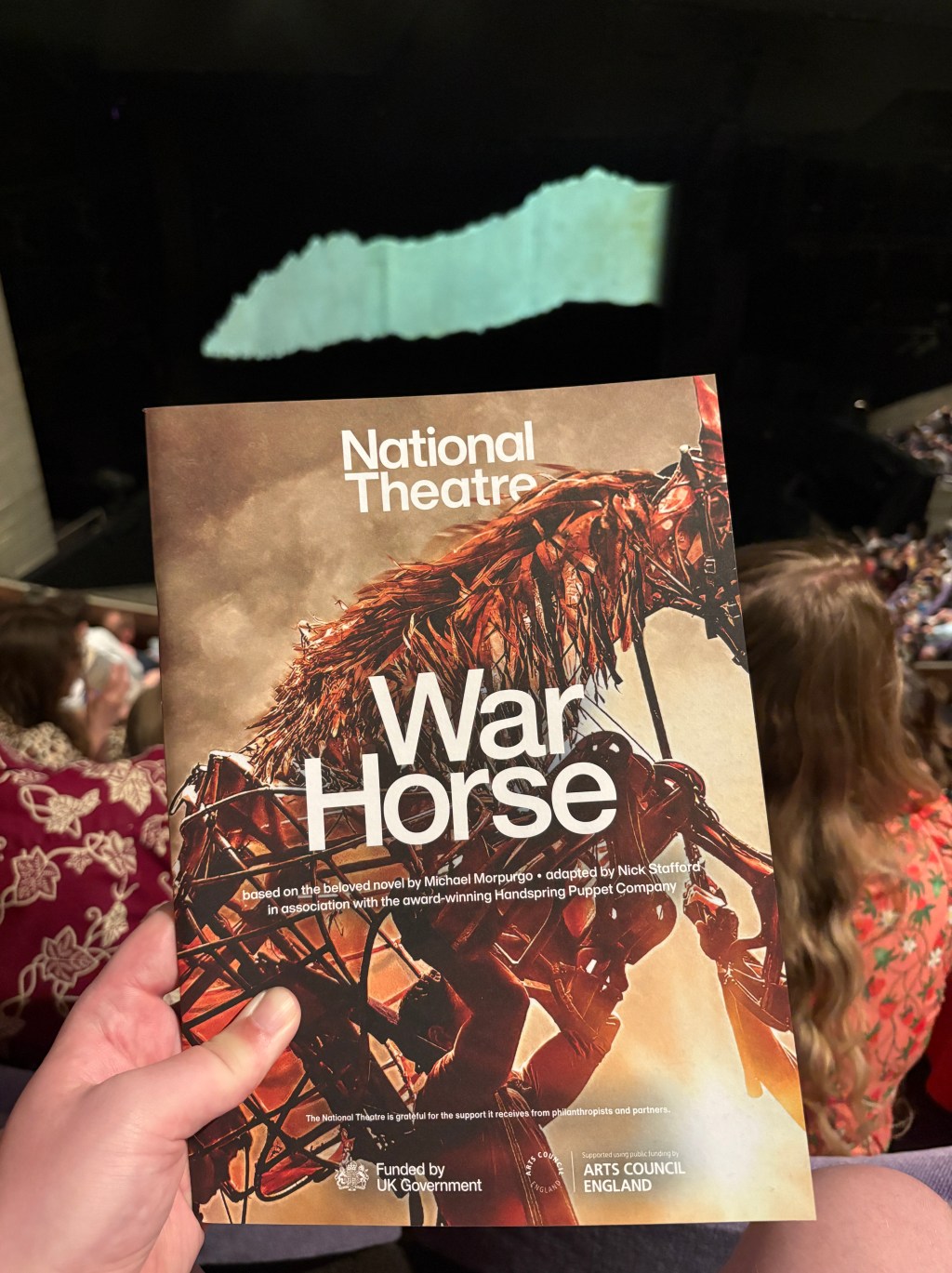
There are few pieces of theatre that leave me speechless. War Horse was not quite what I had anticipated. The puppetry stole my heart, the moments of suspense kept me on the edge of my seat, and despite a cast of more than 30, the production feels intimate and immediate, yet somehow sweeping and cinematic.
The narrative itself is surprisingly episodic. Joey’s journey, from a spirited foal and unlikely farm horse to an unwilling participant in the First World War, provides the emotional heartbeat of the production. Albert may be the tether that holds the story together, but it is Joey we follow. Act One takes its time establishing their bond, while Act Two unfolds through a succession of wartime encounters. Yet the individual moments carry such emotional force that the production ultimately proves devastating.
There are few theatregoers who cannot recall the astonishing horse puppets from the Diamond Jubilee Pageant or the National Theatre’s 50th anniversary celebrations. Quite how the mind stops seeing puppets and starts believing, with complete conviction, that several fully grown horses are galloping into battle, I am not entirely sure.
That act of collective imagination lies at the heart of War Horse. The production rarely presents a complete picture. Scenery emerges through the sketches of a soldier’s notebook, battlefields are suggested rather than shown, and entire worlds are built from fragments, movement and implication. Somehow, what is implied often feels more vivid than what is placed directly before us.
The silhouette of a tank towers above Joey. There is no escape. The tension is palpable. It is only a shadow cast across the stage, yet the mind does the rest, transporting you directly into the moment. You can almost feel the danger scraping past your face. Breath held, you find yourself asking the same question as everyone else in the auditorium: can Joey escape the inevitable?
Joey’s entanglement in the barbed wire remains one of the most extraordinary sequences in the production. The stage picture is deceptively simple, yet the audience fills in every awful detail. What should feel theatrical instead feels agonisingly real, transforming a few strands of wire into a moment of genuine desperation. Suddenly, the war is no longer an abstract backdrop but an immediate and terrifying reality.
The choreography feels claustrophobic and tightly controlled, yet expansive, perfectly reflecting the contradictions of war itself. Book, direction and stagecraft work in remarkable harmony to create a strange limbo-like state in which the audience assembles complete images from incomplete information. It is perhaps the production’s greatest achievement.
Even from the back row of the Olivier’s vast circle, I felt completely absorbed. The production is sleek, relentless and, when required, astoundingly quiet. It is not the noise or spectacle that proves most affecting, but the confidence to slow down and allow characters, moments and horses room to breathe.
Those quieter passages are also where the production occasionally struggles. I understand their purpose. These moments of humanity amid the chaos of war are fundamental to both the novel and the play. They are often the scenes that give the story its emotional power. Yet they can feel overextended, making it difficult for the production to regain momentum. While I struggle to imagine how else they might be staged, I could not shake the feeling that the evening would benefit from being 20 minutes shorter.
I’m not convinced the film adaptation diminished the impact of the stage version. Iconic sequences such as the tank attack, Joey’s entanglement in barbed wire, and a reunion that by all rights should never have happened remain deeply affecting. Yet they are merely landmarks along the way. What makes War Horse extraordinary is everything that surrounds them.
This is not a tale of morality, judgement or adventure. It is a tale of consequence, humanity and danger; of people and animals swept along by decisions made far beyond their control. The play never suggests that individual decency can prevent catastrophe. Rather, it argues that humanity persists despite it.
That is where War Horse separates itself from so much contemporary theatre. It never lectures. It never insists. It never tells its audience what to think. Instead, it presents its world with confidence and trusts us to find our own meaning within it.
Nearly twenty years after its premiere, War Horse remains one of the most extraordinary theatrical achievements this country has produced. It is only a shadow cast across a stage, a sketch on a page, a collection of puppets manipulated by visible performers. Yet the mind does the rest.
And that is where the magic lies.
 Colin Cushion
Leave a comment