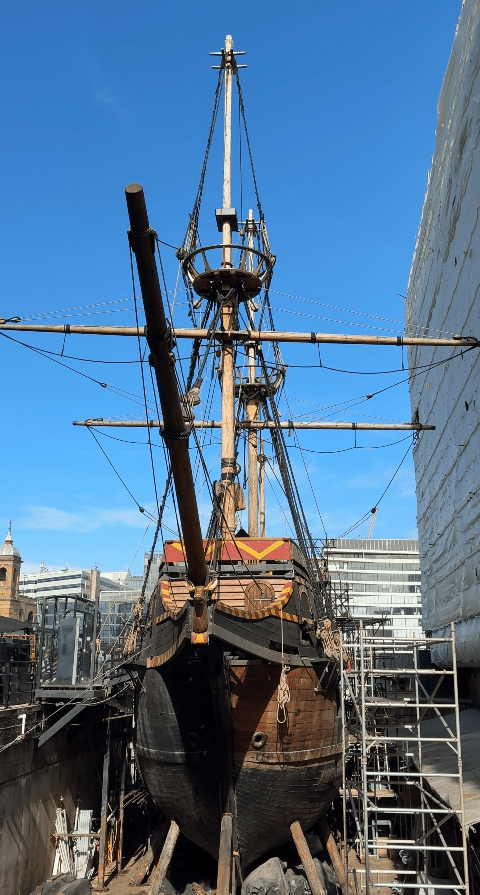
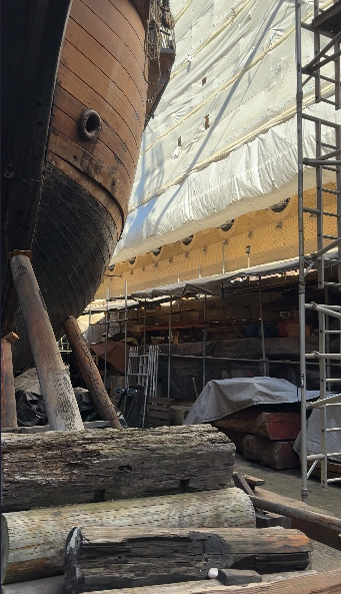
I first arrived at the Golden Hinde in St Mary Overie Dock, beside Southwark Cathedral and Borough Market, on 17 March 2026. Blue skies and a modest temperature made it an ideal day to take in the ship’s surprising scale, laid bare during ongoing preservation work. The port side reveals raw timber while the starboard remains painted, a vessel caught between maintenance and display.
She has travelled more than 100,000 nautical miles since her construction, more than 60,000 further than the original Golden Hinde. Since 1996, hundreds of thousands of people have stepped onto her decks in London alone.
Aimee Parnell and Luke Pereira welcomed me aboard. They came to the ship from very different starting points. For Aimee, the connection began long before she worked there, shaped by a longstanding interest in maritime history.
“You don’t need to ask me about Drake or the Armada… I know all about that stuff.”
Luke arrived from hospitality, events and theatre with little knowledge of Francis Drake.
“I didn’t really have any knowledge of Francis Drake at all before I started. It’s kind of been a baptism of fire… definitely a learning journey.”
That difference reflects the Golden Hinde itself: a ship rooted in history, sustained by people bringing different experiences to its future.
Aimee is clear about the purpose. “The primary mission is education. It always has been.”
That mission shapes the pricing. “It’s a deliberate decision by the family to keep the price point as low as it is. We could easily double all of the costs, £6 general admission, £20 for a group of four. The education price is £8 per student, and teachers go free.”
In a part of London where a day out can quickly exceed £20, the Golden Hinde remains deliberately accessible.
A ship with a family history
Built at Appledore Shipyard in Devon and launched in 1973, the replica began life as a travelling vessel, undertaking voyages that included the United States as part of commemorative events linked to Sir Francis Drake. After touring extensively, she returned to the UK and became a permanent educational attraction in London.
For Angus Francis Coleman, the ship has been part of life for as long as he can remember.
“It’s something I’ve never not known. I’ve been lucky enough to grow up alongside it. My dad has had the ship for longer than I’ve been alive.”
His father, Roddy, became involved in the 1980s and bought her in 1984. Angus recalls giving tours from the age of six.
“I’ll need to get my children involved at some point… and I’m sure they’ll be just as annoying as I was.”
The family connection survived periods of uncertainty. Between 2003 and 2017, the Golden Hinde was run by a series of charitable trusts before the family resumed operational control.
“Even if we were a charity, the money available is very limited, and there are a lot of organisations competing for it,” Angus explains. “The ship is a wonderful asset, but it’s still relatively young compared to others, so it can be a tough position.”
Public funding has played only a limited role. Aimee notes support received during the pandemic through the Job Retention Scheme and Culture Recovery Fund, plus an £800 grant from National Historic Ships UK towards replacing the mizzen mast.
“We sit in a strange space,” Angus says. “We’re not a historic building, so the funding available for those doesn’t usually apply to us… and because there aren’t many ships like this, it’s not always a priority.”
The vessel therefore depends on a combination of admission, events, education and the continued commitment of the people responsible for her.
Keeping history alive
She is currently undergoing an extensive refit yet remains open to the public. Progress has slowed in part because the entrance needs to be relocated so work can proceed on the starboard side, the most visible part of the vessel. Plans include improving accessibility with a ramp to the main deck, though the nature of a historic ship places natural limits on what can be achieved.
Most visits last between 20 minutes and an hour. Standing within the hull, the scale shifts. Even a crew of 17 to 20 would have lived in close quarters, made more striking by comparison with the 70 to 80 who sailed on Drake’s original voyage.
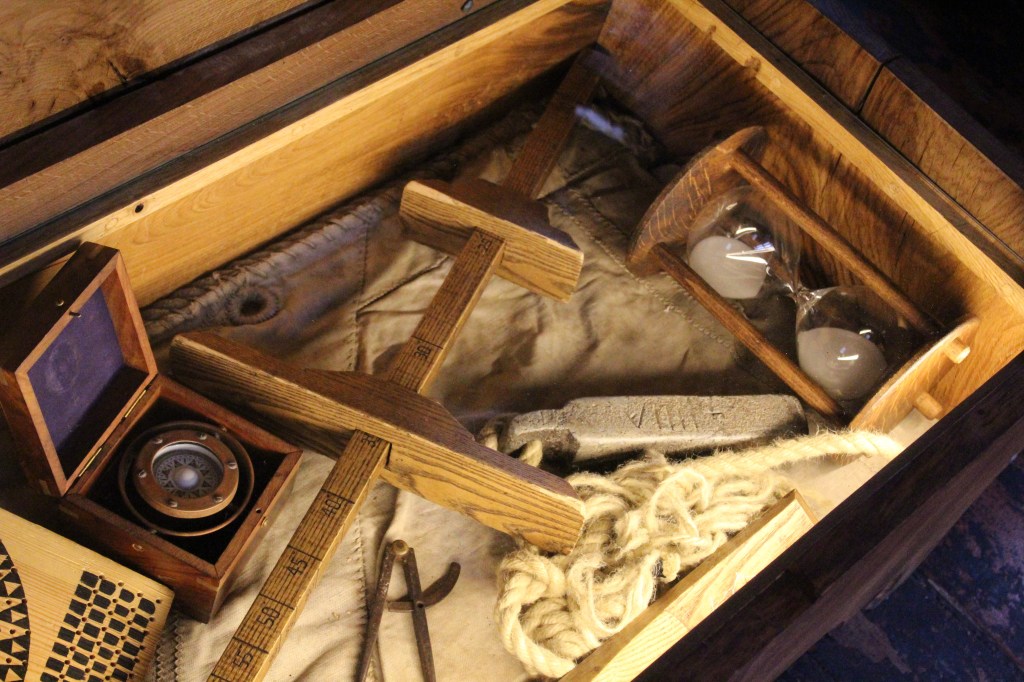
“The value of her is how tactile she is… it’s the smell of wood,” Luke says.
That physical presence is central to the way the Golden Hinde tells its story.
Visitor expectations have changed, creating tension between preservation and audiences accustomed to screens, audio and guided experiences.
“It’s an evolving conversation… I don’t think we can ever rule anything out,” Aimee says.
Angus is wary of technology overwhelming the experience. “We have to be careful not to have too much information… people end up on their phones the whole time… the aim is for people to be looking at the ship.”
For Luke, the answer is to make additions “work symbiotically with how the ship is… to keep telling the story authentically while promoting these new offerings.”
The ship itself remains the story.
Finding an audience
That story had to find its audience again after the pandemic. Visitor numbers fell by roughly 50 per cent, from about 50,000 walkaboards to around 25,000. Recovery has involved expanding events and education while rebuilding general visitor numbers.
“We’ve grown the events like five, sixfold… education maybe like 10–15 per cent… and we’ve slowly gained back the general visitor numbers,” Angus says.
Collaboration has helped.
“I’ve never worked in a sector that’s so collaborative and sharing… there’s no real element of competition,” Aimee notes.
The Golden Hinde sits alongside Southwark Cathedral, the Old Operating Theatre and Shakespeare’s Globe. Joint initiatives create a more connected Bankside experience. Around 95,000 people pass through the area daily, so thousands encounter the ship whether they planned to or simply noticed her while walking between Tate Modern and Borough Market.
Raising the flag for the Pearl of Bankside
I returned later in 2026 as the ship celebrated 30 years at St Mary Overie Dock and was named one of four National Historic Ships UK Flagships of the Year after a successful bid in a highly competitive process.
Hannah Cunliffe explained that the awards recognise vessels on the National Register of Historic Vessels with the highest planned public engagement activities, allowing them to act as ambassadors for National Historic Ships.
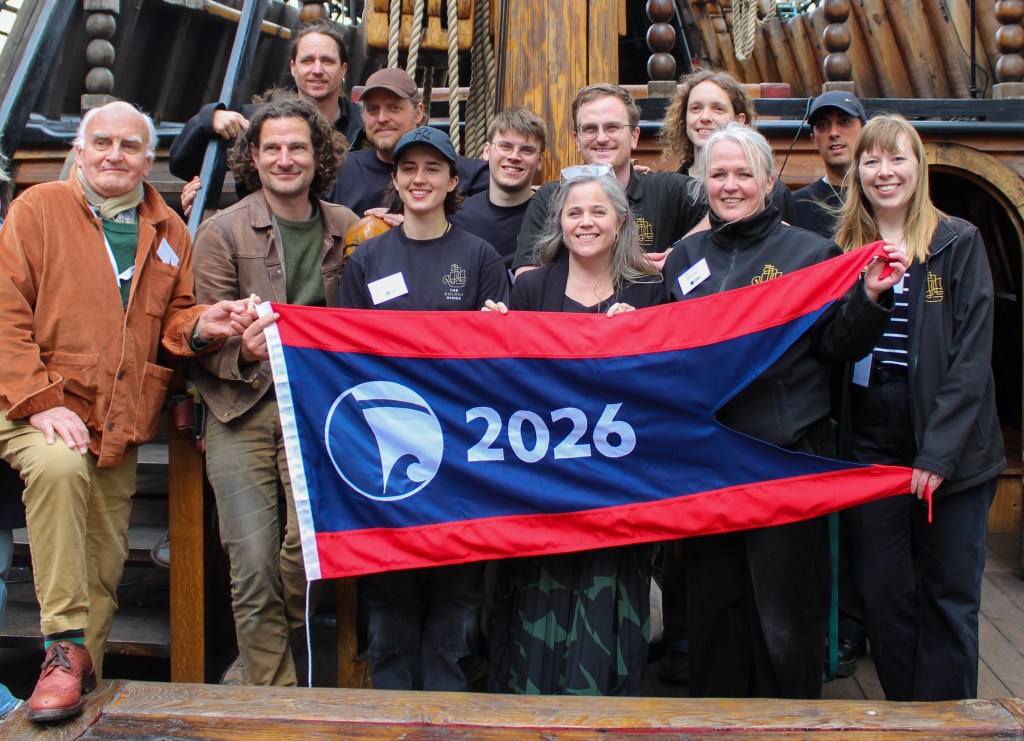
Despite threatening clouds and strong winds along the Thames, the rain held off as guests gathered beneath the rigging for the hoisting of the Flagship pennant.
Angus welcomed the recognition. “It’s great to see such strong engagement and recognition here. This designation is an important milestone for us, but equally important is seeing so many people sharing in that recognition and supporting what we do.”
Neil Coyle praised the team, describing the award as recognition not only of the vessel but of “the people who maintain, who interpret and who animate this ship for our community and for everyone who visits from across the country and across the globe.”
Visitors quickly showed why that recognition matters.
One, discovering the ship en route, said: “My son’s wife said it was very interesting to visit. And it was on my way from modern Tate to where I go. It’s fantastic to see a real ship like that.”
Another reflected: “It’s the first time to be on a ship like this in our whole life and it’s incredible to think about what these people have done inside this ship and what this ship had experienced in the past…”
The low beams, narrow staircases and cramped decks replace romanticised notions of adventure with a more immediate sense of the realities sailors once faced.
A third chapter
Angus describes the Golden Hinde’s current phase as its “third chapter”, following its global education mission and arrival at St Mary Overie Dock in 1996. Education remains at the heart of everything, while its relationship with Londoners and the local community is “absolutely central”.
Its significance is not solely the story of Francis Drake or the original vessel.
It is also the story of the replica itself: launched in Devon in 1973, travelled the world, found a permanent home beside the Thames, and survived changes in ownership, financial uncertainty, a pandemic and an ongoing refit.
And then there are the people who keep it alive.
Aimee, with her longstanding fascination with maritime history. Luke, who arrived knowing little of Drake and learned through the ship. Angus, who grew up alongside it and now works to secure its future. And the visitors who climb aboard for 20 minutes, an hour, or simply because they noticed an enormous wooden ship sitting beside the Thames.
Whether they arrive intentionally or stumble across it between Tate Modern and Borough Market, the Golden Hinde continues to do exactly what it was built to do: transport people somewhere else entirely, if only for a little while.


Leave a Reply