
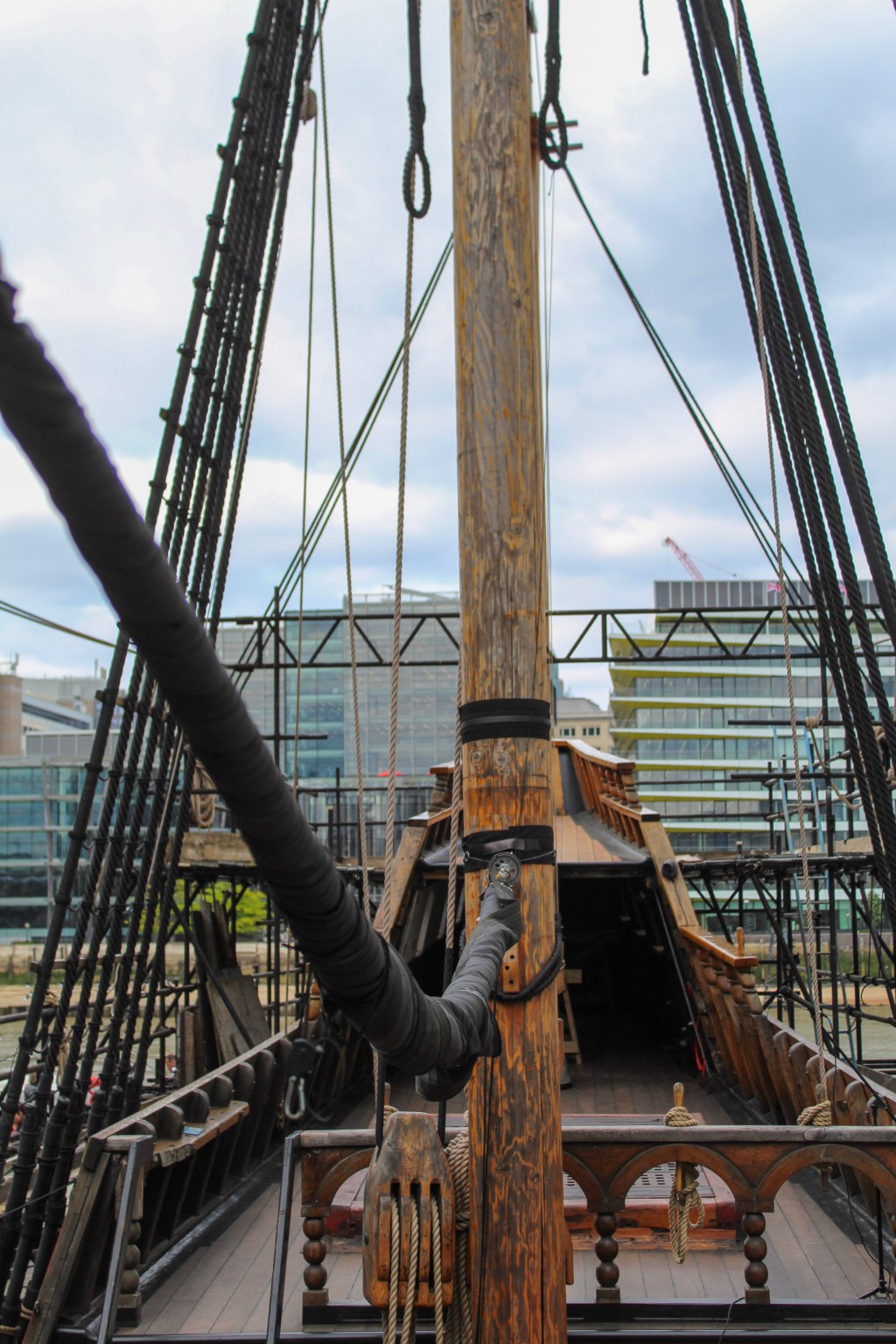
On 17th March 2026, I arrived at The Golden Hinde in St Mary Overie Dock beside Southwark Cathedral and Borough Market. Blue skies and mild temperatures made it an ideal day to take in the ship’s surprising scale, laid bare during ongoing preservation work. The port side reveals raw timber while the starboard remains painted, leaving the vessel caught somewhere between maintenance and display.
She has travelled more than 140,000 miles, over 100,000 miles further than the original Golden Hind, and since arriving in London in 1996, hundreds of thousands of people have stepped aboard.
I was welcomed by Aimee and Luke, who arrived at The Golden Hinde from very different backgrounds but now share responsibility for helping to sustain her.
Aimee’s connection to the ship began long before she worked there. Growing up in Devon, from the same town as Drake, she was already familiar with his story through school and local history. During her interview, she told Angus and Roddy: “you don’t need to ask me about Drake or the Armada… I know all about that stuff.”
Luke arrived with a very different perspective, bringing a background in hospitality, events and theatre. Reflecting on his early days aboard, he says: “I didn’t really have any knowledge of Francis Drake at all before I started. It’s kind of been a baptism of fire… definitely a learning journey.”
For Aimee, the ship’s purpose is simple.
“The primary mission is education. It always has been.”
That mission shapes everything aboard The Golden Hinde, including its pricing. “It’s a deliberate decision by the family to keep the price point as low as it is. We could easily double all of the costs, £6 general admission, £20 for a group of four. The education price is £8 per student, and teachers go free.”
In a part of London where even a modest day out can quickly become expensive, Bankside still offers something different. With a little planning, it remains possible to spend a full day in the area and still come away with change from a £20 note.
Sustaining The Golden Hinde requires long-term commitment. Angus’ connection to the ship stretches back decades, shaped in part by his father, Roddy, who bought the vessel in 1984.
Built at Appledore Shipyard in Devon and launched in 1973, The Golden Hinde began life as a travelling vessel, undertaking voyages including trips to the United States as part of commemorative events linked to Sir Francis Drake. She later toured extensively before returning to the UK and eventually becoming a permanent educational attraction in London, where she has remained ever since.
“It’s something I’ve never not known. I’ve been lucky enough to grow up alongside it. My dad has had the ship for longer than I’ve been alive,” Angus says.
“I was giving tours at about six. I’ll need to get my children involved at some point… and I’m sure they’ll be just as annoying as I was.”
Preserving a historic replica is not as straightforward as it might appear. Explaining some of the challenges faced by the team, Aimee says: “Roddy bought the ship in ’84. Between 2003 and 2017 it was run by a series of charitable trusts, which didn’t go very well, so the family took back operational control in 2017.”
That history still shapes the ship’s present. Angus adds: “Even if we were a charity, the money available is very limited, and there are a lot of organisations competing for it. The ship is a wonderful asset, but it’s still relatively young compared to others, so it can be a tough position.”
Public funding has played only a limited role in sustaining The Golden Hinde. Aimee points to support received during the pandemic through the Job Retention Scheme and the Culture Recovery Fund, alongside a small £800 grant from National Historic Ships UK towards replacing the mizzenmast.
“That’s the extent of our public funding,” she says.
The challenges are not just financial, but structural too. Angus explains: “We sit in a strange space. We’re not a historic building, so the funding available for those doesn’t usually apply to us… and because there aren’t many ships like this, it’s not always a priority.”
Despite ongoing restoration work, the ship remains open to the public. Progress has slowed in part because work must take place within the ship’s existing structure, particularly on the starboard side, the most visible and public-facing part of the vessel.
There are also plans to improve accessibility. The team hopes to install a ramp providing access to the Main Deck, although, as a historic ship, there are natural limitations to what can realistically be achieved.
On board, the experience is brief but immediate. Luke tells me most visits last between 20 minutes and an hour, shaped as much by the size of the ship as by how people choose to engage with it.
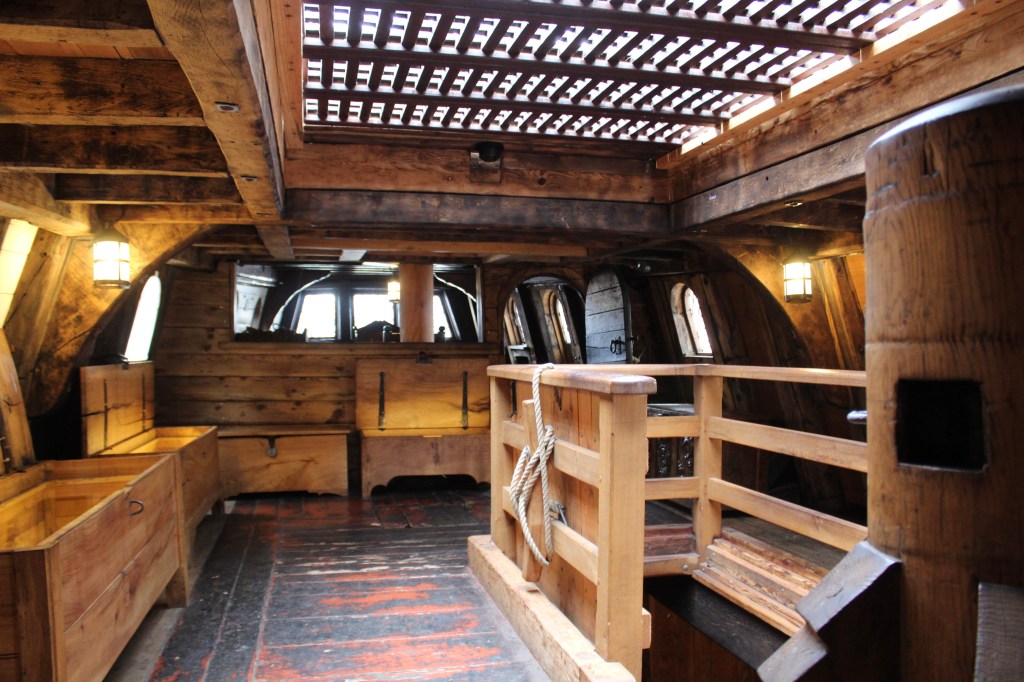
Standing within the hull, its scale quickly begins to shift. Even a crew of 17 to 20 would have lived in close quarters here, a contrast made more striking when set against the 70 to 80 people believed to have sailed on Drake’s original voyage.
The physical reality of life aboard soon becomes impossible to ignore.
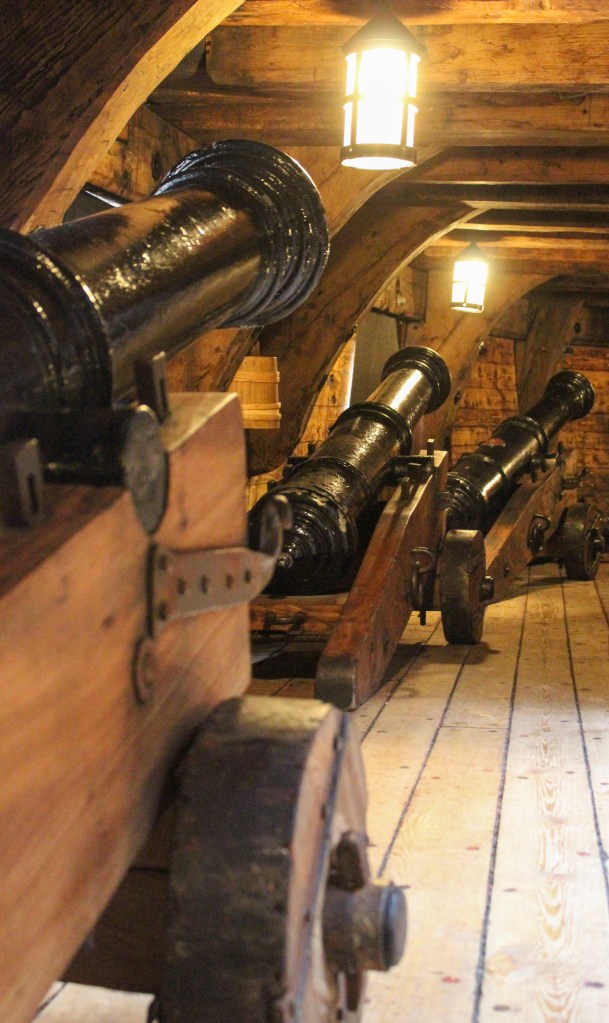
Crew members would have navigated low beams, weaponry and constant hazards as the ship battled rough seas. Even now, standing motionless in dock, moving through the space requires bent knees and a curved neck. The men aboard were no smaller than those on land, despite popular myths, yet dozens would have attempted to sleep in these cramped conditions at any one time.
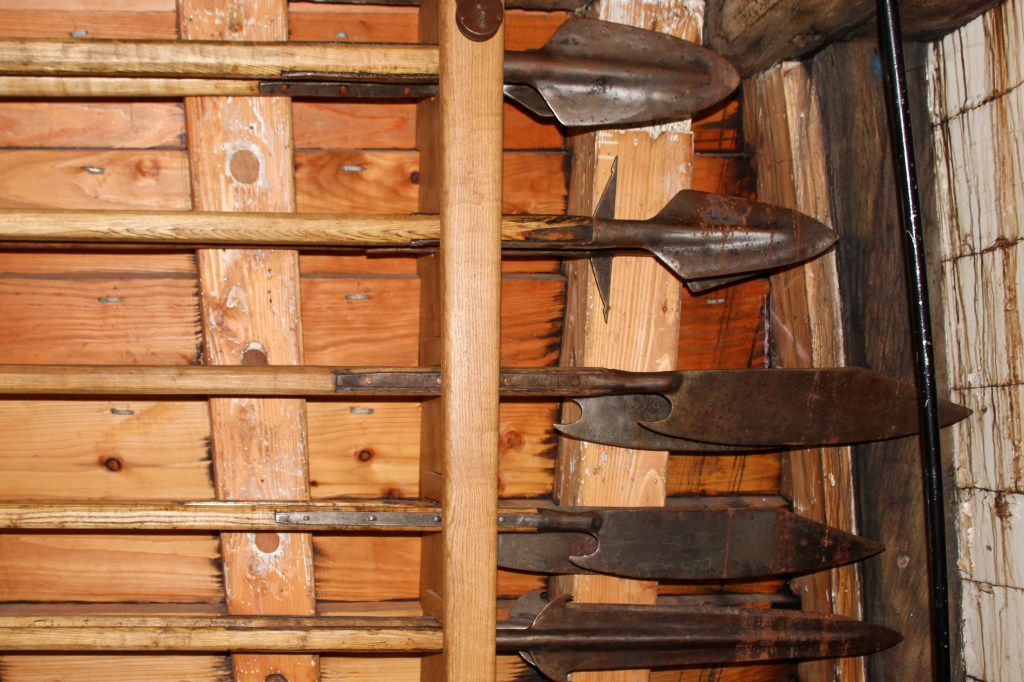
There was no dedicated space for rest. Sleep happened wherever it could, around noise, movement and the demands of life at sea.
Food offered little comfort. Preserved provisions such as salted pork and fish, chosen for their ability to survive long voyages, would have been a daily staple.
And if you needed the toilet, the head of the ship, extending from the bow, was fitted with slats for exactly that purpose.
“The value of her is how tactile she is… it’s the smell of wood,” Luke says.
Visitor expectations, however, continue to evolve.
To meet those expectations without overwhelming the experience itself, visitors can access additional interpretation through the Bloomberg Connects app, offering an optional digital layer alongside the ship rather than replacing it.
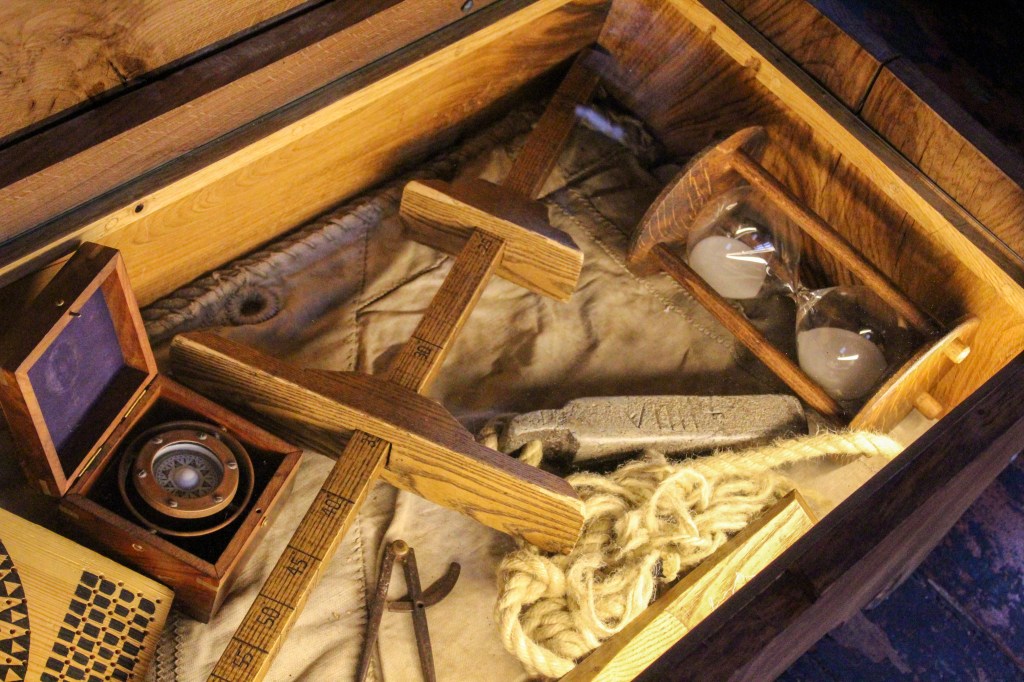
As Aimee puts it: “it’s an evolving conversation… I don’t think we can ever rule anything out.”
Angus is clear that too much digital layering risks pulling attention away from the ship itself.
“we have to be careful not to have too much information… people end up on their phones the whole time… the aim is for people to be looking at the ship.”
The challenge, as Luke describes it, is making any additions “work symbiotically with how the ship is… to keep telling the story authentically while promoting these new offerings.”
Visitor numbers, Angus explains, have now recovered to pre-pandemic levels following a sustained effort to rebuild engagement.
“We saw roughly a 50% drop… from about 50,000 walkaboards to about 25,000,” he says. “We’ve grown the events like five, sixfold… education maybe like 10–15%… and we’ve slowly gained back the general visitor numbers.”
Collaboration has also played an important role in that recovery.
“I have never worked in a sector that’s so collaborative and sharing… there’s no real element of competition,” Aimee says.
The Golden Hinde sits alongside Southwark Cathedral, the Old Operating Theatre and Shakespeare’s Globe, which celebrates its own 30th anniversary next year.
“We work closely with Southwark Cathedral. We’ve got a joint ticket with the Globe,” she adds.
As The Golden Hinde celebrates its 30th year in London, ongoing restoration work and a growing programme of events point towards something actively maintained rather than simply preserved.
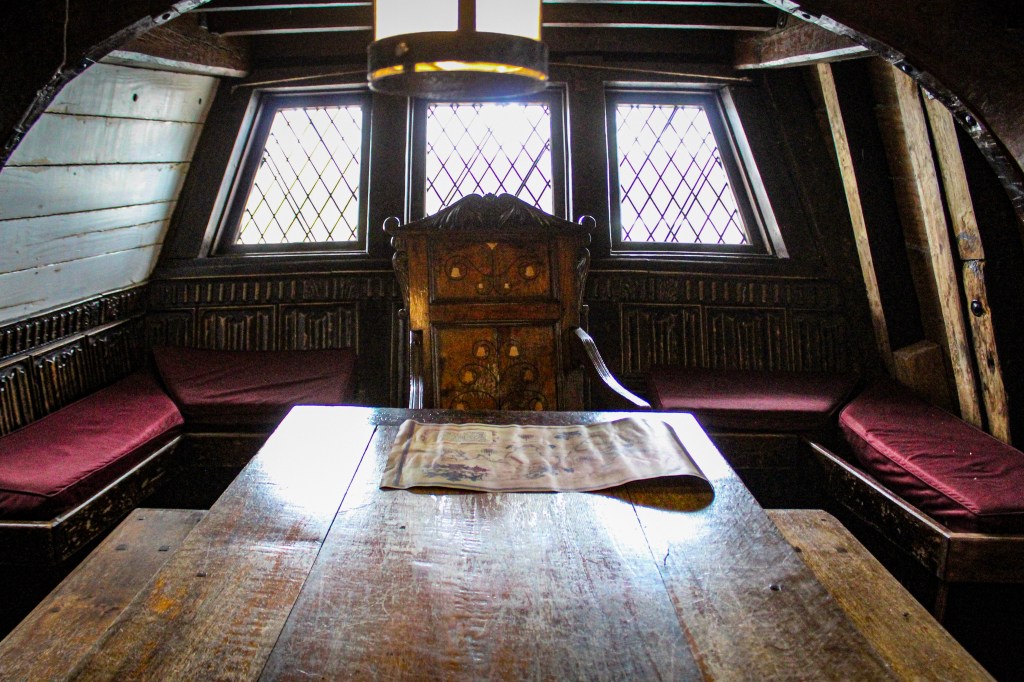
Stepping aboard, even briefly, makes that clear. The ship’s resilience is matched by the people sustaining her, ensuring her story continues to feel alive in the centre of modern London.
 Colin Cushion
Leave a comment