
George Naylor is magnetic in this production. His energy keeps the audience engaged even as the exposition spirals and the plot threads multiply.
The story is difficult to pin down. Too many ideas compete for space, and it is not always clear which threads matter. Yet the result remains compelling, driven by Naylor’s performance and striking staging.
Almost all of the show’s flaws are offset by its visual ambition.
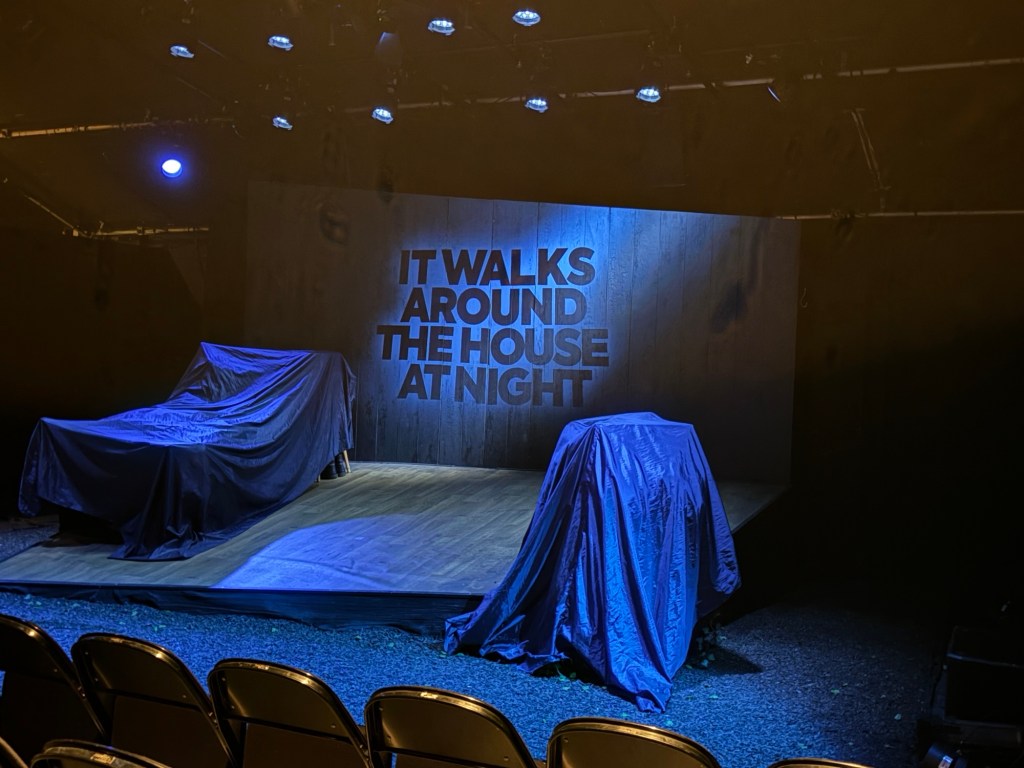
Neil Bettles and Tom Robbins’ set, paired with Joshua Pharo’s work, is pushed to its limits. Projections are used with purpose rather than excess. Several jump scares land cleanly, while lighting, choreography and physical effects combine to create moments that feel cinematic in scale. Pete Malkin’s sound design supports this effectively, though it could be pushed further to deepen the more unsettling moments.
Each time the production seems to reach its visual peak, it finds another way to expand. One sequence, as the protagonist flees the shadows, is genuinely striking.
This is where the production hesitates.
It builds tension, invites the audience to sit with it, and then pulls back. The instinct to soften the scare limits its impact. A moment illuminated only by a phone torch taps into something genuinely unsettling, recalling The Woman in Black, but the production rarely commits to that register for long.
That tension between ambition and restraint runs throughout.
Tim Foley’s script, under Bettles’ direction, aims high, but the storytelling occasionally tangles itself. Too many characters compete for attention, several serving little purpose beyond complicating the final act. Clarity also becomes an issue. Some phone exchanges are difficult to follow, and the final twist arrives before it has time to properly land.
At times, the production feels caught between a stage thriller and a cinematic horror translated for theatre. A clearer commitment in either direction would strengthen it considerably.
The comparison that comes to mind is Ghost Stories. That production builds tension but, for some, lacks visual impact. Here, the balance is reversed. The imagery dazzles, even when the narrative struggles to keep pace.
One staging choice stands out. At Southwark Playhouse Borough, the set sits slightly off-centre, leaving a pocket of darkness to one side. From that angle, the empty space feels charged, as though something might emerge. Whether intentional or not, it heightens the atmosphere.
This resurgence in staged thrillers is promising. The Woman in Black remains the benchmark, but this production feels distinct, much as Paranormal Activity did within its genre.
This play feels close to something exceptional. With greater confidence in its scares, and more restraint in its storytelling, it could become something genuinely striking.
It is worth seeing while it runs.
 Colin Cushion
Leave a comment